
CROSSOVER LADDERS AND PLATFORMS
A crossover ladder or platform enables workers to step over conveyor belts and pipelines instead of climbing around them. Our crossover platforms come in aluminum for lighter, mobile setups or steel for permanent, heavy-duty crossings, and each one is built to OSHA standards. Industrial crossover ladders range from simple single-step designs to multi-point access for wider or taller obstacles. If a standard size doesn't fit your layout, call us to talk through a custom build.


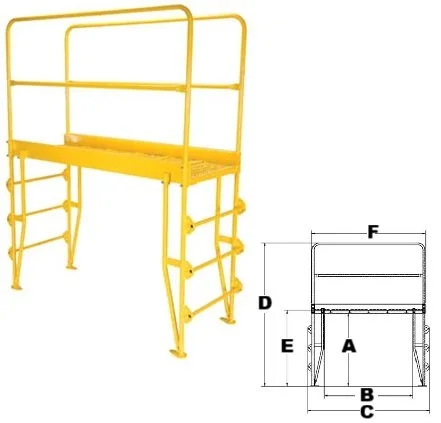

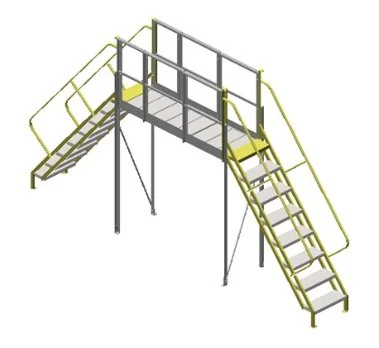

Crossover Ladders That Don't Cut Corners on Safety
Conveyor lines and pipe runs create daily obstacles that tempt workers to step over or climb around them. A crossover ladder gives your team a defined, code-compliant path over obstructions, keeping feet off equipment and reducing the near-misses that turn into recordables. Our industrial crossover ladders and platforms handle that job in manufacturing, warehousing, aviation, and utility sites, in configurations that run from a low single step-over to a full elevated walkway with guardrails on both sides.
PlatformsandLadders.com is committed to being your source for Crossover Ladders (aka Crossover Platforms). Our products are designed to fit a wide variety of industries and applications. Our Crossover Ladder product line includes Aluminum Crossover Ladders and Stainless Steel Crossovers as well as Space Saver models. We also offer "off the shelf" Custom Crossover Ladders that can be used in low height Crossover applications.
Aluminum Crossover Ladders are manufactured with ease of mobility in mind and are a top choice with customers needing to cross over conveyor belts and other hazardous areas. Our Crossover Ladders can be mounted at the legs for a more permanent solution or used with the non-marring rubber legs for easy mobility.
Stainless Steel Crossover Ladders are available as a special order custom product and can be used when wash down, corrosive or heavy duty applications are needed.
Custom Crossover Ladders can be ideal to cross over low trip hazards such as water lines and electrical conduit.
Crossover Ladders may be ideal for the following applications:
Traversing conveyor belts
Avoiding trip hazards
Access to controls and/or gauges
Elevated platform for supervisors
Crossing over pipelines
Improved time and motion
How To Spec a Crossover That Fits
Getting the right crossover ladder depends less on the product name and more on the obstacle in front of it. Before you request a quote, it helps to pin down the height and width you need to clear, how often people will cross, and whether the unit should stay put or move with your layout. Getting those details right up front means the ladder shows up ready to use.
Clearance and Step-Over Height
Measure the tallest point you need to clear and the width of the obstacle. Those two numbers drive the step count and the platform length, whether you're crossing a low water line or a tall conveyor.
Traffic Flow and Footprint
Frequent, two-way foot traffic calls for a shallower 57- or 60-degree stair and a roomier top platform. Tight aisles are better served by a space-saving vertical crossover that climbs closer to 90 degrees.
Mounting and Mobility
Bolt-down legs make sense for a permanent route over fixed equipment. Non-marring rubber feet or casters let you reposition the crossover when your floor plan changes.
Talk Through Your Application Before You Buy
Every crossover ladder we sell can be adjusted to your dimensions, and any custom build starts with a drawing you approve before production. Send us your measurements and a note on what you're crossing, and we'll match you to a standard unit or quote a custom one. We'll also shop freight rates on your behalf so delivery is handled. Reach us through our contact page or call (888) 802-3651 to get started.
Why Buy Your Crossover From Platforms and Ladders
We've sourced industrial access equipment since 2014 and carry OSHA-compliant lines from trusted manufacturers, so you get the crossover that fits your application instead of whatever happens to be in stock. Our staff knows these products well enough to help you spec one correctly the first time; we will often match a lower price on identical items, and we shop freight rates on your behalf. As a GSA contract holder and certified MBE, we're also a straightforward fit for government and enterprise purchasing.
Please call and speak with one of our industry leading staff members for answers to any product related questions, get a freight quote, purchase one of our Industrial Crossover Ladders or ask about a custom solution to best fit your particular application requirements.
Crossover Ladder FAQs
-
It depends on how your team uses it. Most of our crossover platforms sit at a 57- or 60-degree slope, which falls in the ship-stair range OSHA allows for steeper access. Where floor space is tight, a vertical crossover climbs closer to 90 degrees in a much smaller footprint.
-
No. Under OSHA's walking-working surfaces rules, employees need a safe way to cross powered equipment, such as conveyors. A crossover ladder or platform is the standard fix, keeping people off the moving line and off improvised steps that create fall and entanglement hazards.
-
Many of our standard crossovers, including the rooftop and vertical space-saving models, carry a 500 lb working load, which covers a worker with tools and materials. That rating reflects OSHA's structural rule that stairs and platforms support at least five times the anticipated load and never less than a 1,000 lb concentrated load. If you need a higher-capacity or heavy-duty unit, tell us, and we'll spec one to match.Description text goes here
-
Yes. We offer rooftop platforms and crossovers built for exterior use, and aluminum models hold up well against weather and corrosion. For wash-down or chemical areas, stainless steel is available as a custom order. Slip-resistant tread is standard, so footing stays secure in wet conditions.